
Relative Age Effect
How to maximize individual development and team performance
Hi there,
You don’t have to choose between development and winning - you can have both.
What looks like “natural talent” is often just an early maturity advantage, amplified by the system of early selection and opportunity.
What is the Relative Age Effect?
Relative Age Effect (RAE) is the phenomenon that children born early in the year are selected for teams at a higher rate than those born later in the year. When grouping kids by the calendar year, those born in January are almost a year older than those born in December. At younger ages this is significant. The biologically advanced athlete is bigger, stronger and faster with better cognitive skills and motor coordination.
Early-born players are more likely to be chosen for teams, get better coaching, and receive more confidence boosts. This early advantage accumulates over time.
Late-born/biologically delayed players are more likely to be cut from teams, become frustrated and stop playing.
Impact and Opportunities
It’s not all bad news for the late-born athletes as they can catch up and surpass the early-born players. This tends to happen in the U20/Junior level of play as the maturity gap disappears.
The biologically delayed player has had to survive a system that is unintentionally rigged against them. They have learned ways to be effective players. This compensation lends to the development of better technical skills and tactical awareness. They are forced to use varied methods of making plays. They learn to find space, evade defenders with skill and smarts and use their teammates by passing. Their technical skills, vision, and decision-making has allowed them to stay competitive.
Their survival through disadvantage requires effort, grit, resilience, and adaptability; critical skills and predictors of success when advancing to higher levels of sport.
A Note for the Coaches and Parents of the Early-Born
There is a risk to the early-born and biologically advanced athletes. By relying solely on superior physical skills they may not develop a well-rounded game capable of adapting to higher levels of play when everyone else is just as big, fast, and strong.
A common example is a player will beat multiple players on their way to scoring a goal. They get reinforced by coaches and parents for how good they are, receiving a confidence boost which promotes more plays of similar nature. The problem is that playing this way is not transferrable to higher levels when the maturity gap diminishes.
In order to help the early-developing players maintain their status as a top player they need to develop their technical skills and decision-making. They should be encouraged and taught to find various solutions to make plays rather than rely solely on their physical advantage. We should be teaching them to grow their tactical awareness such as how to manipulate the defense and pass to open teammates.
Further Reading
The RAE was popularized by Malcolm Gladwell in his book, Outliers, where he highlights how a disproportionate number of elite Canadian hockey players are born in the first few months of the year.
It’s a fantastic read; check it out HERE.
A useful study to go deeper on this topic is the Relative age effects and player pathways in international ice hockey: a longitudinal multi-cohort analysis HERE.
Bio-banding
Bio-banding is the process of grouping athletes on the basis of attributes associated with growth and maturation rather than chronological age. The intent of bio-banding is to reduce the maturity gap, promote skill development and reduce injuries.
Elite soccer academies are leading the way in bio-banding and it is being used in other sports such as rugby, tennis, gymnastics, and ballet.
It’s an interesting topic to consider the practical applications of bio-banding in youth sports.
For a full article, check out: Bio-banding in sport: applications to competition, talent identification, and strength and conditioning of youth athletes
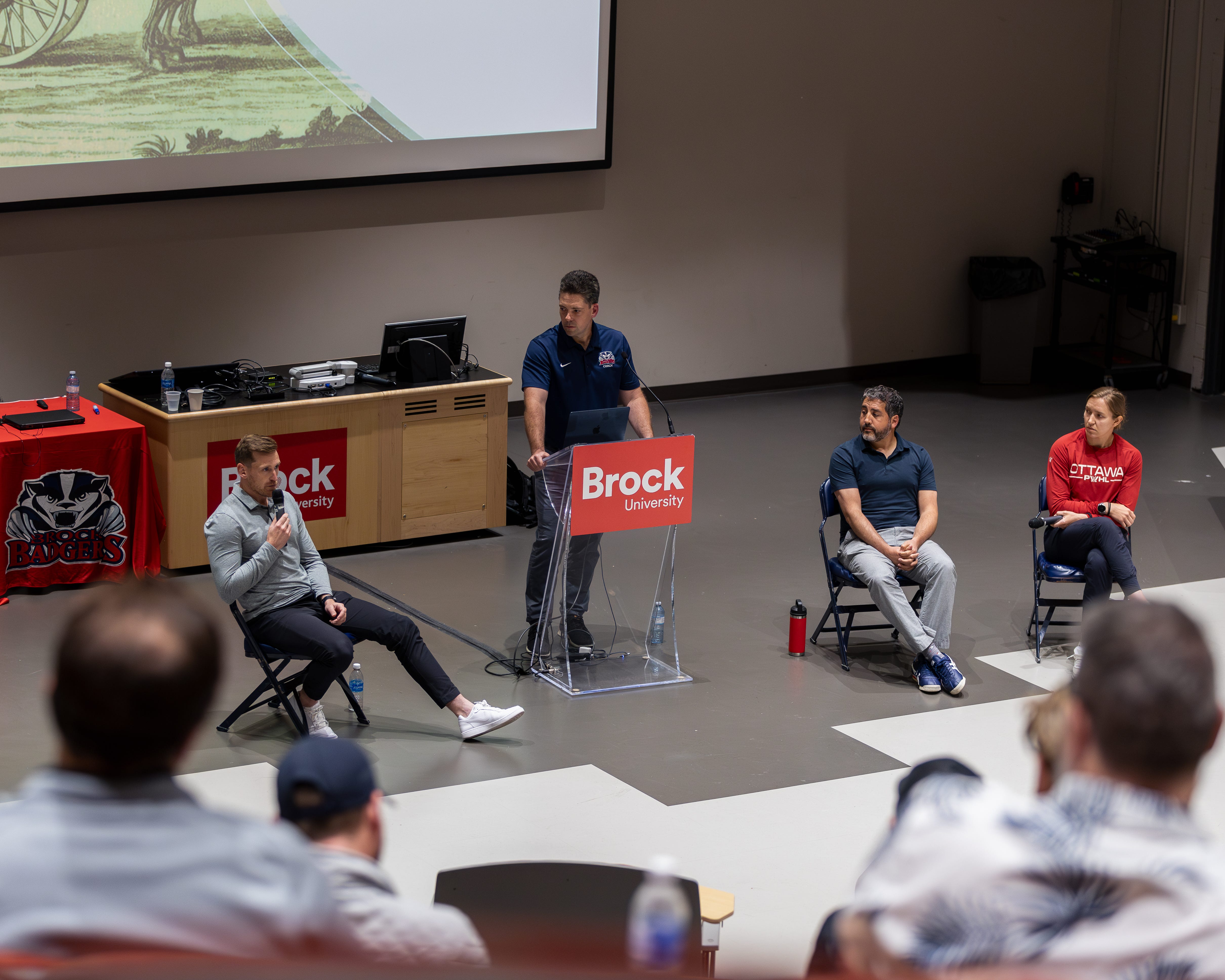
Brock Badgers High Performance Hockey Seminar
Purchase the video of all presentations from the 2023, 2024, and/or 2025 seminar for just $74 (CDN). Email me directly at tmanastersky@brocku.ca for details.
Click here for the 2023, 2024, and 2025 agenda including speakers and topics.
About the seminar…
Learn, share, and connect with coaches, scouts, managers and industry professionals from all ages, genders, and levels on the campus of Brock University in the beautiful Niagara region.

Click here for the 2023, 2024, and 2025 agenda including speakers and topics.
Purchase the video of all presentations from the 2023, 2024, and/or 2025 seminar for just $74 (CDN). Email me directly at tmanastersky@brocku.ca for details.
Cheers,
TJ Manastersky
Coaching Project
Follow the Coaching Project on Twitter here
If you are new to the Coaching Project newsletter, you can find the past editions here.